Showing posts with label Literature. Show all posts

Monday, December 22, 2014

A Whirlwind Review of Seven Worthy Books

(Minor spoilers throughout this blog post. Proceed with caution! You have been warned.)

To the Lighthouse by Virginia Woolf- All right, this is not a worthy book; at least, not in my opinion. To the Lighthouse is a story about the ill-fated Ramsay family and their guests at their summer home over two visits. When this book was written, in the 1920s, after World War I, the young set were disillusioned with anything solid and predictable, such as religion or government. World War I was the "War to End All Wars" and people were trying to come to terms with what would come next. Artists and authors were popping up everywhere; people experimented with feelings, art, sex, drugs, dancing, music, the human psyche (in the form of psychology); those who experimented with these things in the extreme were called Bohemians and Virginia Woolf and her friends were a part of that circle. Bohemian experimentation and disillusioned aimlessness show themselves clearly in To the Lighthouse.
There is no plot to speak of and most of the book is stream-of-consciousness narrative. The reader gets to see the character's innermost thoughts. Unfortunately, these thoughts are not worth seeing. Mostly, the characters bemoan their lives and bottle up their feelings. Take Mr. and Mrs. Ramsay, for instance: there is a scene where Mr. Ramsay, looking at his wife, is thinking "I wish she would just tell me she loves me. I know she does, but it would be nice to hear it." Mrs. Ramsay is thinking, "He wants me to tell him that I love him, but I just can't say it out loud. He knows I love him." If the characters addressed their feelings, if they talked about their emotions, instead of bottling them up, they may have led happier lives and not been so miserable. And, as a result, THIS reader would not have been so miserable.
This book depressed me because the characters were so purposeless and hopeless; they were stuck and they were stubborn about being stuck; they felt they couldn't change. I am firm in my belief that you are never stuck in or with one choice. You can always change if you want to, especially if you have God.
Although I did not enjoy many elements of this book, I did enjoy some of Ms. Woolf's descriptions and it was vastly interesting to read a style of writing that I don't usually read. Another perk to this book is that it is short.


The Ankulen by Kendra E. Ardnek- This book follows Jen as she is sucked into her own imagination (which has been missing for the past few years) which is being eaten by the many-headed Polystoikhedron. She must save her imaginary friends and their world.
This book is very innovative and creative (it is a book about imagination, after all!) and I think my friend Kendra is the only one who would ever be able to write such an idea so wonderfully!
When I read back-cover synopsis' or blurbs on the author's website, my brain tricks me into thinking that the whole story is contained within the summary when, usually, there is SO much more going on in the story. In that way, The Ankulen surprised me. I had expected it to be a story simply about a girl exploring her lost imagination and destroying the monster that preyed on it. The story, however, dived quite deeper and included allegorical elements that I wasn't expecting, but enjoyed. There were a few parts that got a little too spiritual* for my comfort, but I think that's just a denominational difference. Since I can't remember what the parts were at the moment (it's been six months since I read the book), I won't elaborate. Perhaps I shall do so in a fuller review sometime in the future.

*Spiritual isn't exactly the word I'm looking for... but it will do in place of the word that has escaped my memory.


The Invention of Hugo Cabret by Brian Selznick- This wonderful children's book follows the adventures of young Hugo who lives and works in the Paris train station. He fixes the station's clocks and, in his spare time, tries to fix an automaton (pronounced: aw-taw-ma-taun) which had been in his late father's possession. Hugo gets entangled with Melies family and it becomes apparent that Papa Georges Melies is much more than he appears, and he knows more about Hugo's automaton than he lets on, too.
I love love love this book. Half the book is told in illustrations, like a stopmotion film, while the other half is written in normal prose. Both the story and the wonderful illustrations are done by Brian Selznick. I am fairy certain that he will someday be ranked among the finest children's book writers and illustrators, right up there with Maurice Sendak (and not just because they both have funny names) and Howard Pyle.
The book's magic does not end with its peculiar storytelling method. Indeed, one of the most endearing things about this book is the historical part. Georges Melies was a real man; he was one of the first men to create moving pictures at the end of the 1800s. He made hundreds of films, many of which, sadly, have not survived. Still, a great many are on Youtube. George Melies was not only a filmmaker, but also a magician, so many of his movies feature magic tricks and show-stopping stunts. He also had a substantial collection of automatons. Automatons are mechanical figures, run by clockwork, that "exhibit human characteristics," as Google put it. They were popular entertainments for the rich and they were employed by magicians chiefly in the 1700s-1800s. Sadly, the making and preserving of such works of art has rather slipped through the hands of many historians.
Brian Selznick, however, by writing about these two important but nearly forgotten and infinitely interesting historical curiosities—Georges Melies and his films and automatons—preserves an eccentric and somewhat trivial piece of history.
I feel like a kind of kindred spirit to Mr. Selznick because I, too, enjoy little-known, quirky areas of history (such as the story of the Collier brothers) and I am all for saving as much history as possible, especially if it is such beautiful history such as automatons and some of the earliest films.
While the historical side of things may be lost on younger readers—the targeted age group—it adds a rich layer to the story, something that most books today are sadly lacking. Also, this book certainly piqued my curiosity on automatons and, after some research, I find myself fascinated with them! Perhaps you will be too, after watching this video:


The Railway Children by E. Nesbit- Roberta, Peter, and Phyllis' lives are turned upside down when their father is taken away by strange men, forcing the three children and their mother to move out of their expensive home to a cottage in the country. Although they do not have much to live on, the children fall in love with the countryside and the nearby railroad. They have many adventures on the railroad and make many new friends, though their missing father is always in the back of their minds.
E. Nesbit is one of my favorite authors. Her books are utterly delightful and just the sort of story I enjoy reading: children having adventures.
One brilliant thing about this story—and The Enchanted Castle, the other E. Nesbit book I have read—is that it doesn't have one singular plot, until the end. Every chapter is its own self-contained adventure (like a novel made up of short stories) but, in the end, everything is connected together, like train couplings (okay, bad simile, I admit). There is something satisfying about reading meandering adventures that don't seem to be headed anywhere, only to find that, indeed, they were all connected and important. Its as if, halfway through the story, the author suddenly realizes she needs an overall plot, only the transition between self-contained chapters and a cohesive novel isn't bumpy, but smooth.
Another asset to this book's charm is that it is about trains and the railway. My love of trains started with Thomas the Tank Engine when I was three years old and has continued until today. Trains hold a fascination for me and I think I would rather travel by train than any other sort of vehicle.


If you enjoy E. Nesbit or stories about children having adventures or novels with self-containing chapters or all three, try reading The Penderwicks by Jeanne Birdsall or A Long Way From Chicago and A Year Down Yonder by Richard Peck.

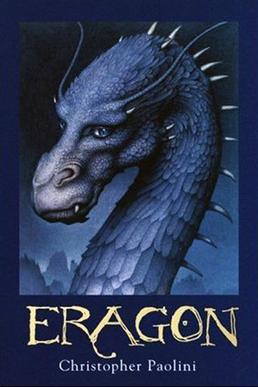
Eragon by Christopher Paolini- Eragon finds a blue stone in the woods which soon hatches into a dragon! Eragon keeps his new pet a secret, but that doesn't stop the Ra'zac—servants of the Empire—from getting suspicious and burning Eragon's uncle's farm. Eragon is forced to flee with his dragon, Saphira, and the old storyteller, Brom, who turns out to be much more than a storyteller. As they hunt down the Ra'zac, Brom teaches Eragon swordplay and magic and Eragon realizes that he and Saphira are far more important than either of them realized.
I enjoyed Eragon. I think its a good work of fantasy and Christopher Paolini must be credited for creating a working, coherent fantasy world. I enjoyed Eragon's growth throughout the book. I did, however, feel like Christopher Paolini "borrowed" too much from other franchises. Continually, I was saying to myself, "This reminds me of Star Wars!" or "This reminds me of Lord of the Rings!" and not, necessarily, in a good way. While it is good to learn from successful authors, to borrow too much from them is dishonest, even if it is unconsciously done.
Still, Eragon was an enjoyable book. I loved Paolini's take on magic. Magic in Paolini's book comes from a language of power, and using that magic costs the strength of the user. I thought that was really unique and more "realistic" than stories where magic does not "have a price," as Rumpelstiltskin would say in Once Upon a Time.

Ivanhoe by Sir Walter Scott- Ivanhoe is an exhilarating tale filled with knights, competitions, a damsel or two, and more than one familiar face. It is set during the Third Crusade—also known as the time of the Norman takeover, the time of Richard the Lionheart, and the time of Robin Hood—and follows the intersecting story lines of several characters. Ivanhoe, recently returned from the Holy Land, and his Saxon relatives clash with their Norman adversaries, Prince John ("Too late to be known as John the First, he's sure to be known as John the wooorst!") is trying to steal the throne from the missing King Richard, and Isaac the Jew is trying to protect his daughter, his hide, and his gold from persecutors.
So much goes on in Ivanhoe that I find it hard to write about. Really, all I can say about the whole book, and not just parts, is that it is epic and definitely worth reading.
My favorite characters were Wamba the Fool and Rebecca the Jewess. Her speeches against the Templar Knight's advances were wonderful; her loyalty to her faith astounded and inspired me. The Templar offered her love and riches—he even risked losing his status in his order just to woo her—but through it all, Rebecca remained stalwart in her Judaism. Honestly, I don't know if I would have persisted in my resistance, had I been in Rebecca's place. By standing strong in her faith, Rebecca shows women that they don't need a man to be content; God will fill the void, if you let him. Even if a man offers love and riches and even goes so far as to risk his reputation for you, it does not mean that he Mr. Right, especially if he means giving up your faith and your scruples. Rebecca is an unsung heroine of literature, I think. Her only fault is in her rejection of Jesus Christ as Lord and Savior.


Persuasion by Jane Austen- Kellynch Hall has become too expensive for Sir Walter Elliot's style of living and he and his eldest daughter must remove to Bath and rent the Hall. Anne Elliot, Sir Walter's second and often forgotten daughter, goes to stay with her younger sister's family, the Musgroves, where she meets with a former suitor and falls in love all over again. 
Persuasion is a lovely read. As it is one of Austen's last novels, it is more mature in its style; the heroine is certainly no Elizabeth Bennet. It is a rather quick read, only twenty-some chapters long, but it is full of delightful characters and a variety of different settings. I have enjoyed all of Jane Austen's novels (except Northanger Abbey, which I have not yet read), but I have especially enjoyed her more subdued novels like Mansfield Park and Persuasion. This book is a great read!

What have YOU all been reading lately?

Live long and prosper.

Wednesday, April 2, 2014

Nightstand Books: The First

Nightstand Books is exactly what it sounds like: a post of what books are on your nightstand! This fun, new linkup is hosted by the fabulous Jenelle Leanne Schmidt and DJ Edwardson.
The first Wednesday of every month, you simply take a picture of the books that are currently on your nightstand, and write a post about them! (and link up with the others doing it)
You know me, I love talking about the books I'm reading... and this is the perfect opportunity to!
Without further ado... my nightstand:


Starting at the top, we have Great Expectations by Charles Dickens. I'm reading this for literature class and really enjoying it so far! Technically we're still on Wuthering Heights (which I also enjoyed... review coming in the nearish future) but I really wanted to get Great Expectations finished before the middle of this month, for secretive reasons I shan't disclose at the present. (Mwahahaha.)
From what I heard about Dickens, I had great expectations for Great Expectations (see what I did there?). Alright, maybe not great expectations, per se... But from what I had gleaned from other readers, Dickens is really super tough to read and get through. That had me apprehensive, but I was happy to find that he's not so difficult to understand after all! His writing style is similar to Jane Austen's in that it's old fashioned, but not indiscernible.

Next there is Thank You, Jeeves by P.G. Wodehouse. I discovered the world of Wodehouse in February and have fast fallen for his brilliant writing style and characters. His Jeeves books are definitely not to be taken too seriously and they make excellent brain candy reading. Thank You, Jeeves is the first Jeeves and Wooster novel (before it come several short story collections) and I'm enjoying it tremendously! My favorite episode of the TV series is based off of this story.

Third down is Jane Austen's Letters which is exactly like it sounds: a collection of Jane Austen's letters. Most of them are to her sister Cassandra and are, altogether, very interesting! I love reading people's letters or autobiographies, especially if the people lived in a historical time period. Textbooks and Wikipedia pages can only tell you so much about that time... but reading the everyday occurrences of someone who actually lived at the time can be so enlightening! It's like a peek into a different world.

Which brings me to... Agatha Christie's Autobiography. Everything I said about the above also applies to this book. Wow, what an interesting person Agatha Christie is! I recently finished a book of her letters to her mother when she traveled around the world with her husband in the 1920's (it was so so so good) and figured I'd just move right along into her autobiography. I haven't gotten too far into her life yet. She's only just entered the teen years. Did you know she never really wrote much as a child? She loved to read, and she had many make believe worlds and friends (including several imaginary train tracks in her backyard), but she never wrote. Instead she played piano, acted, danced, swan, and learned French. She wasn't an outstanding child - actually, she was rather normal. Her childhood games reminds me of my own.

Underneath those four books are three or four notebooks, several pieces of paper, and a folder or two. All are filled with stories or story ideas. Aaaand up in the left hand corner, you can see Dori photobombing. I decided to have his make a cameo appearance instead of the other half of my nightstand, which is the top of my dresser. It's rather messy, filled with bits of paper and bookmarks. I didn't think you'd be interested in that.

So what are YOU reading?

Live long and prosper!

Thursday, January 16, 2014

A Miniature Literature Review on Canterbury Tales.

Canterbury Tales by Geoffrey Chaucer!


This book is an epic poem about a diverse group of people on a pilgrimage (which, for 14th century guys, is kind of the equivalent of a vacation) to the city of Canterbury. On the way, to entertain themselves, each member has to tell two stories. The Host, when they reach Canterbury, will determine the winner and everyone else will have to buy him a meal.


The book is comprised of the stories of the various persons involved.


Since there are many types of people (merchants, nuns, monks, rich lady, lawyer, cook, physician, pardoner, etc. Even Chaucer himself is one of the pilgrims!) there are many types of stories. There were some really good stories... and there were some horrible stories that I wish I had never read. The good ones had near-perfect women who ran into hardship but persevered by trusting God. A good message, though the characters were flawless and a bit unbelievable.
The bad stories... (the Miller's Tale and the Reeve's Tale were the worst) were absolutely horrible. I was reading the Penguin Classics version which translated all the old-English poetry into modern language. Let me tell you, the Miller's Tale and Reeve's Tale were very explicit! And it wasn't like TV, that you could turn your head away. If any of you ever read Canterbury Tales, do yourself a favor and skip those two. Those two tales were the whole reason I marked it down to a four of ten stars.
The language was pretty cool... and I admire the person who made translated it all into modern English. That's a lot of poetry and rhyming! I admire Chaucer too... He came up with a whole new style of writing to write his poem in - Iambic Pentameter! Those familiar with Shakespeare probably know what Iambic Pentameter is, as Shakespeare wrote in it. Chaucer was the one who made it up.
Basically, it is a form of poetical speech that, if you read it, it will come out in a ba-dum-ba-dum-ba-dum-ba-dum-ba-dum form.
Try it out for yourself! (Shakespeare's Sonnet #12) When-I-do-count-the-clock-that-tells-the-time,
And-see-the-brave-day-sunk-in-hid-eous-night...
One thing I really like about Canterbury Tales was the framed narrative. A framed narrative is essentially a story inside a story... A good example is the One Hundred and One Nights/Arabian Nights... The king's wife, to stay alive, must tell stories to the king every night before he goes to bed. There's that plotline, and then there's the all the stories she tells him inside of that.
Canterbury Tales is like this too. It has the overarching plot of travelling to Canterbury (they never actually reach it... the story is unfinished. Or is it? There's lot of debate over that) and then there's all the stories that the pilgrims tell.
Another thing that I think is cool about the story is that Chaucer puts himself in as one of the pilgrims. He tries to tell a story but is shot down 'cause it's too boring, so he tells a different tale.


I rated this book a 4/10 stars. I didn't particularly enjoy it and found it a tedious read. A lot of the stories had similar plots and themes and I kind of felt like I was reading the same thing over and over again. Stick in the two explicit stories, plus some others that were just plain gross/rude, and it didn't make for an enjoyable read. At least for me. I think that if we had had time to study it in depth I would have enjoyed it more.
So, if you are ever going to read this, I would encourage doing lots of homework and deciding which tales are alright to read, and which ones you should skip over.


Live long and prosper.

Friday, December 20, 2013

Snow!

Remember this post?


It snowed!


Yay!

So what does Abbey do when there's snow?
She builds things! But not normal things. Oh no. Normal people make snowmen. I make... well... just take a look:


They are a nice family of snow people that my mom and I made in 2002. We made them while my dad was at work, so when he came home, he could barely get his car into the driveway.

Perhaps some of you remember this guy from last year?


This year I was going to recreate this (from Calvin and Hobbes):


But then I decided, why stick at that?
So I decided to create the scene from The Old Man And The Sea where Santiago is losing the fish to the sharks.
Behold!


I wrote out a scene from The Old Man And The Sea to hang above it.
I was going to add a scene from Moby Dick in the background... but then it started raining.
 
 
Live long and prosper!


Monday, April 29, 2013

That's right, folks! It's time for another book review!

Title: The House of Mirth (which is taken from a verse in Ecclesiastes. It is better to go to a house of mourning than to go to a house of feasting, for death is the destiny of everyone; the living should take this to heart. Ecclesiastes 7:2).

Author: Edith Wharton.

Synopsis: In 1905, Lily Bart is part of the elite group of fashionable rich society in New York. But slowly her extravagant tastes exceed her small income. Further thrusting her out of society is the implied - but totally untrue - accusations by her friends of having an affair with a married man.

My rating: 8/10 stars.

Why I liked the story: The story is so fabulously interesting. There were very few high class families with a lot of money in the early 1900's. Most people, like today, were middle class or lower class.
Though some may find it dry, it is very, very interesting and I thought the writing style was beautiful.
You can clearly see the downfall of Lily... which I think is a cool writing technique. You can see her go from rich to poor and also lose some of her prejudices in her downfall. It's really cool.
The characters are pretty cool too. I especially like Gerty Farish and Seldon... though he's kind of sad.
Lily's morals are somewhat mixed, but good overall. I appreciate that. She won't create a scandal (even though her friends are weaving one around her).

What I didn't like/things you should know/some more of my thoughts: It can be confusing sometimes because of the writing style... Lots of big words strung together and old fashioned terms. It can also be confusing because there are SO many characters!!! Lily Bart, Seldon, Gerty, Carry Fisher (haha. You Star Wars fans get that), the Gormers, the Brys, the Trenors, the Van Alstynes, the Van Osbourghs, the Dorsets, Mr. Rosedale, the aunt lady whose name I forgot... Ned Silverton... Grace Stepney... Jack Stepney and his wife Grace.... That's about all the main-est ones... There are a few other characters too. Talk about confusing! Oh... I forgot Percy Gryce and Lily's two employers (because she is brought low enough that she has to work at the end of the book. There's also Hattie and her husband George... They have a baby that Lily holds near the end of the book).
This is kind of a depressing book. You kind of feel like yelling at Lily the whole way through the book. She loves wealth and money and comfort but she doesn't have money and is in debt, just to fit in with her rich friends. She needs (and she longs) to marry someone rich so that she can pay off her debts and to continue the rich life. But somewhere in the back of her mind, Lily knows that is a futile way to live. But she loves comfort and rich stuff too much to give it up. She is also somewhat in love with Seldon which stops her from marrying Percy Gryce. It also stops her from doing some bad things later on in the book.
Anyway, she has several instances where, had she said yes, she would have been happy. She doesn't though, and ends up... well, read the book and find out. It doesn't end happily.
There are the hinted at affairs.... People think that she has an affair with two married men. That doesn't actually happen. Some other characters, however, do have affairs. Nothing is explicit, though, since this was written in 1905. Also, it is kind of hard to pick out the real meaning of some of the things said because of the old fashioned language (which, for some reason, is harder to read in this book than in Jane Austin!).
A few bad words scattered here and there. Nothing too horrible.

Have I read it before? Nope.

Will I read it again? Probably sometime in the future!

Would I recommend it: I would, but to certain audiences. If you aren't a fan of depressing, descriptive, social commentaries, this book isn't for you.

Live long and prosper! I'm off to write write write! Camp NaNo ends tomorrow!!!!

Saturday, March 30, 2013

The Adventures of Huckleberry Finn - A review.

I recently (as in two or three days ago) finished The Adventures of Huckleberry Finn by Mark Twain for literature.


Title: The Adventures of Huckleberry Finn.

Author: Mark Twain (real name, Samuel Clemens)

Synopsis: Huck Finn escapes town with a runaway slave, Jim, and they travel down the Mississippi River together and have many an adventure.

My rating: 6/10 stars.

Why I liked the story: It was VERY entertaining. Huck and Jim get into a lot of scrapes and usually they are pretty humerus. Plus, Mark Twain's writing style in itself is very funny.
He had some really great descriptions.... Some that made me laugh out loud. .....Something about the meat was harder than chewing on an old corpse.
The plot twist near the end when Tom Sawyer showed up... That was really funny! My mom thought it was too far fetched, but I loved it.
So (spoilers!) Huck goes to this house because they're holding Jim and trying to give him back to his rightful owner (except they have the wrong address). Huck is going to try and rescue Jim but the lady of the house comes running out and says she's so glad to see Huck. She thinks that Huck is her nephew. Her nephew Tom Sawyer! Well, then Tom comes... And Huck pretends to be Tom and Tom pretends to be Sid (his brother). Tom agrees to help Huck rescue Jim but he insists on doing it the right way. AKA, making it as complicated as possible (when all the while, Jim is actually a free man because his former owner died and set him free in her will).
Anyway, there's one part where Huck and Tom are trying to roll a giant grindstone into the shack where Jim is being held and they can't do it by themselves so they go and slip Jim's chain off the bed and get him to help. Then they slip it back over the bed because they aren't done rescuing him yet. It was really outrageously funny....
Mark Twain really seemed to know what he was talking about. After all, he was a riverboat pilot for awhile. I think that he did a good job of portraying life on the River in the 1840's.
Huck and Jim's friendship is very nice. Even though the Civil War wouldn't happen for 20 years in the book.... Huck is ahead of his time - he realises that Jim is a man, just like himself.

Things I didn't like/things you should know: The main reason that I will not be re-reading this book anytime soon is that I didn't like the unchecked lawlessness/Godlessness. Mostly all the characters are immoral, lie, and cheat. Hardly anyone raises a finger against them.... Although the King and Duke (two con men) do get tarred and feathered for conning the people up and down the river.
Huck's father was an alcoholic who beat and yelled at his son, stole all his money, and drank it away. Huck has very little education and because of this upbringing, he lies. A lot. Usually he gets away with it without anyone being the wiser. Sometimes he struggles with morals... Should I turn Jim in or not? In the end he ends up saying no, I will continue to break the law (of the times) and keep running away with a runaway slave, even if I have to go to hell for it.
So yeah, I didn't care too much for the unchecked lawlessness of almost all the characters.
The characters swear a bit... Also, the N (slang for negro) is used a LOT! That kind of annoyed me... just because I'm not a huge fan of slang terms or swear words (whenever someone swears in a book I feel like hurtling it across the room. It's one thing hearing it on TV... But actually reading the word? Yuck!). At the same time, though, the N word was used a LOT back then. It was the accepted everyday term before the Civil War. It's history. Are we not going to read the story of Solomon in the Bible just because he had 700 wives? That's history too. It doesn't make it right... But that's what was acceptable back then (actually, I'm not 100% sure in Solomon's wives was acceptable... at least in the eyes of God. I can't remember when He said "one man to one woman").

Have I read it before? Nope.

Will I read it again? Probably not... At least not anytime soon.

Would I recommend it? It was a very entertaining read. The lawlessness might not bother some people (on the contrary, the N word probably would.
Random fact: Did you know that Huck Finn was a banned book shortly after it came out in 1884? It was banned because Huck Finn wasn't a "hero." He wasn't the well behaved, wild animal-saving boy people wanted to read about. Now, however, Huck Finn is banned because of the racial prejudices throughout the whole book. It's kind of interesting to compare to two.)
Anyway.... You have to take a grain of salt with this book, I think. It really is in the eye of the beholder. If you are interesting in reading an entertaining classic go ahead and read this book! Just be warned that it is full of racial prejudices and lawlessness.
Although I can't help but wonder if Mark Twain wanted it to be that way because he was trying to write a biography on society.
Anyway, personally, I did not care too much for this book. But other people might.

Live long and prosper!

Saturday, March 9, 2013

Call me Ishmael.

Five weeks, 724 pages, and 135 chapters later.... I did it. I finished Moby Dick. And this is my review.


(Me, at the ocean, reading Moby. Don't steal.)

Title: Moby Dick.

Author: Herman Melville.

Synopsis: "Call me Ishmael. Some years ago - never mind how long precisely - having little or not money in my purse, and nothing particular to interest me on shore, I thought I would sail about a little and see the watery part of the world."
In the first 40-50 chapters: When land gets too boring (or too expensive) Ishmael, the story's narrator (well, sort of... but I'll get to that later) likes to get hired to a ship and sail the seas for awhile. Previously he's only been hired to merchant ships. But this time, however, he wants to experience whaling.
So Ishmael goes to Nantucket, an island off the coast of Massachusetts, and the whaling headquarters - so to speak - of the United States. In Nantucket he meets Queequeg, a cannibal, and they become friends.
They get hired to the ship Pequod and thus the adventure begins.
The next 50-60ish chapters are filed with facts of whales and whaling, with the storyline thrown in occasionally. Ahab, the captain of the Pequod, who is out to get revenge on the White Whale Moby Dick for eating his leg, is introduced; as well as Starbuck, Stubb, and Flask, the first three mates; and the harpooners, Daggoo and Tashtego (Queequeg is also a harpooner).
We get to learn our way around a whale, inside and out, and we learn how a whale is caught, killed, and made into oil.
We also get to see Ahab rile his crew to his cause - catching Moby Dick.
Along it's way, the Pequod meets with other whaling vessels but only stays long enough to inquire if they've seen the White Whale.
The last 10-20ish chapters of the books are mostly about the voyage - conversations between the crew, gamming (meeting) with other whaling vessels, the making of Ahab's new ivory leg (since his other one broke), and finally, in the last three chapters, Moby Dick is spotted and chased!

My rating: 8/10 stars.

My thoughts (because they are too jumbled to be put into good and bad categories): First of all, This book is not for everyone, and certainly not for young people because I was even having a hard time understanding some of the stuff in the book.
That being said, I did enjoy Moby Dick, however tedious it was to read.
For one, it was a LOT funnier than I expected it to be. The first 50 chapters or so (before they get on the whale ship) are really, really funny in their own way. Ishmael bemoans the fact that he has no money and no place to sleep for the night and then he says, "But enough blubbering, we are going whaling and there will be enough of that later."
My favorite part, though, is when Queequeg is getting hired to the Pequod. Ishmael has already been hired, and the staunch Quaker owners of the ship are wary of letting a savage on board. Peleg, one of the owners, didn't quite catch Queequeg's name so he goes around calling him Quohog (and Warthog once) for a few chapters. A 'quohog' is a type of clam. It's really funny.
This book is very philosophical and spiritual.... Herman Melville, the author, grew up Dutch Calvinist, and really, really knew the Bible. He's all the time making allusions to passages in Moby Dick. He gave a lot of his characters Biblical names as well (Ishmael, Ahab, Bildad, Elijah, Gabriel, Jonah....) and they all have meaning behind their names. Ishmael, for example, in the Bible was the first son of Abraham (Abram, then) with Sarah's maid servant Hagar. When Isaac was born to Abraham and Sarah, Abraham exiled Hagar and Ishmael into the desert. The Ishmael in Moby Dick is similarly left alone at the end of the book.... as he is the only survivor after Moby sinks the Pequod.
Though Melville really knew the Bible, I do not think he was a Christian. In the book he kind of puts all religion as one - like, all religions are good and fine and just respect everything. It was kind of disturbing.... In one part Ishmael takes part in worshipping Queequeg's pagan idol and there are many mentions of the devil. Several of the characters are seen as being possessed (although that could be sailor's superstitions out on the sea).
The book is very deep in that way.... Some of the philosophical stuff was way too deep for me to understand, at least right now, since I'm so young.
The characters were really good. You don't really get to know them very well.... I would say the character you most get to know is Ahab, though he certainly isn't the hero. This book doesn't really have a hero.... Ahab is more like an anti-hero. He's after revenge and you can't reason with him, which eventually costs him his life, as well as his ship and his crew's lives.
I still felt a connection to the characters, though. I didn't want them to die at the end of the book. I knew it was coming, but I couldn't help but shout in my head "DON'T FOLLOW AHAB! MUTINY! LEAVE! DON'T LET HIM KILL YOU ALL!"
Strangely enough, the one character I didn't feel too much for was the one that survived - Ishmael. Ishmael is the narrator of the book and has been compared to Melville himself. Both didn't really have a set job; they both went from one job to another, trying to find their place in society. They both tried out sailing (though Ishmael lasted longer than Melville, who deserted his whaling voyage after a few weeks). A lot of the book is actually done in third person. It's as if we were listening in on secret conversation of different crew members... Ahab telling the carpenter to get a new leg, Starbuck fighting with himself over whether to kill Ahab in his sleep, Ahab talking with Pip.... Ishmael wouldn't have been able to hear all these private conversations. Plus he doesn't say, "I snuck down near the Captain's cabin and listened at his door." The narrative is just put down. Occasionally Ishmael will pop back into the story. "I stood on the mizzenmast in a deep reverie... Now that we're here, though, let me tell you about baleen and their use in women's skirts." Personally, I think Ishmael IS Melville. The first line of the book is "Call me Ishmael" which could imply, my friend pointed out, that Ishmael isn't his real name. Call me Ishmael. It reminds me of in Tintin when he says, "My name doesn't matter, but back home they call me Tintin." So, if Ishmael isn't his real name (because I don't think any characters ever say, "Ishmael do this!" or "Ishmael do that!"), his real name could easily be Herman Melville. And since Herman Melville is the author, he has access to all his character's private conversations. So I think Ishmael is Herman Melville (that explains how he survived the wreck at the end as well).
Melville was obviously a genius. He read a tremendous amount about whales and whaling, and also knew the Bible very well, and also knew Shakespeare and other old writings very well. He is constantly making allusions to this whale book, or that Bible verse, or Plato, or a statue in a foreign country, or a painting on the wall of his friend's house. He added so much into his book. It is really amazing how well-read this man was. He was very smart.

Now just a couple things you should know.... There is one chapter, near the beginning, when Queequeg and Ishmael meet. The inn is full and Ishmael has a choice between sleeping on a hard wooden bench, or sleeping in the same bed as a savage (because back then, men shared beds at inns. It happens in Robin Hood by Howard Pyle as well. Poor Robin has to share a bed with the Sheriff of Nottingham if I remember correctly! Back then it was no big deal). Ishmael doesn't want to risk being eaten in the night, so he opts for the bench. It is, however, too small for him and he can't sleep. He decides that maybe the cannibal isn't so bad... and tells the innkeeper to take him to the room. Ishmael gets into bed (Queequeg is out at the moment. Selling shrunken heads) and is almost asleep when Queequeg comes back. They soon become friends. My point is, Melville alludes to them as being almost like a married couple and in the morning, Ishmael wakes up with Queequeg's leg thrown over him. It is quite awkward to read... even though I'm sure Melville didn't mean anything by it. If I had been forewarned about it, maybe I would have been more at ease.
There are also a couple of swear words... of course, since the majority of the book takes place on a whale ship!
And then the spiritual stuff I mentioned above.

Have I read Moby before: No.

Will I read it agian: Yes, definitely. When I'm older.

Would I recommend it? I would, actually.

There is soooo much more I could talk about but I think I'll only pick one last thing, so as not to bore you all.
The ending.
THE ENDING!
Aaarrrghhhh!
So, Moby Dick is mentioned throughout the whole book but doesn't actually make an appearance until the last three chapters. The last three chapters are spent trying to chase him and kill him.
In the last chapter, Moby smashes Ahab's whale boat, sending him flying to his death, and then proceeds to attack the Pequod. Moby smashes the hull of the Pequod several times and ends up sinking the ship. Everyone dies except for Ishmael who is saved by the ship's live buoy (which is actually Queequeg's coffin altered to be a buoy. Queequeg had a coffin made for him earlier in the book when he thinks he's going to die of a fever). Everyone dies and Moby Dick isn't even killed!
724 pages for NOTHING!
And what's worse, Moby Dick is still out there, in the ocean, just ready to attack innocent ships..... Beware. Beware!!

Live long and prosper.