Showing posts with label Jane Austen. Show all posts

Monday, December 22, 2014

A Whirlwind Review of Seven Worthy Books

(Minor spoilers throughout this blog post. Proceed with caution! You have been warned.)

To the Lighthouse by Virginia Woolf- All right, this is not a worthy book; at least, not in my opinion. To the Lighthouse is a story about the ill-fated Ramsay family and their guests at their summer home over two visits. When this book was written, in the 1920s, after World War I, the young set were disillusioned with anything solid and predictable, such as religion or government. World War I was the "War to End All Wars" and people were trying to come to terms with what would come next. Artists and authors were popping up everywhere; people experimented with feelings, art, sex, drugs, dancing, music, the human psyche (in the form of psychology); those who experimented with these things in the extreme were called Bohemians and Virginia Woolf and her friends were a part of that circle. Bohemian experimentation and disillusioned aimlessness show themselves clearly in To the Lighthouse.
There is no plot to speak of and most of the book is stream-of-consciousness narrative. The reader gets to see the character's innermost thoughts. Unfortunately, these thoughts are not worth seeing. Mostly, the characters bemoan their lives and bottle up their feelings. Take Mr. and Mrs. Ramsay, for instance: there is a scene where Mr. Ramsay, looking at his wife, is thinking "I wish she would just tell me she loves me. I know she does, but it would be nice to hear it." Mrs. Ramsay is thinking, "He wants me to tell him that I love him, but I just can't say it out loud. He knows I love him." If the characters addressed their feelings, if they talked about their emotions, instead of bottling them up, they may have led happier lives and not been so miserable. And, as a result, THIS reader would not have been so miserable.
This book depressed me because the characters were so purposeless and hopeless; they were stuck and they were stubborn about being stuck; they felt they couldn't change. I am firm in my belief that you are never stuck in or with one choice. You can always change if you want to, especially if you have God.
Although I did not enjoy many elements of this book, I did enjoy some of Ms. Woolf's descriptions and it was vastly interesting to read a style of writing that I don't usually read. Another perk to this book is that it is short.


The Ankulen by Kendra E. Ardnek- This book follows Jen as she is sucked into her own imagination (which has been missing for the past few years) which is being eaten by the many-headed Polystoikhedron. She must save her imaginary friends and their world.
This book is very innovative and creative (it is a book about imagination, after all!) and I think my friend Kendra is the only one who would ever be able to write such an idea so wonderfully!
When I read back-cover synopsis' or blurbs on the author's website, my brain tricks me into thinking that the whole story is contained within the summary when, usually, there is SO much more going on in the story. In that way, The Ankulen surprised me. I had expected it to be a story simply about a girl exploring her lost imagination and destroying the monster that preyed on it. The story, however, dived quite deeper and included allegorical elements that I wasn't expecting, but enjoyed. There were a few parts that got a little too spiritual* for my comfort, but I think that's just a denominational difference. Since I can't remember what the parts were at the moment (it's been six months since I read the book), I won't elaborate. Perhaps I shall do so in a fuller review sometime in the future.

*Spiritual isn't exactly the word I'm looking for... but it will do in place of the word that has escaped my memory.


The Invention of Hugo Cabret by Brian Selznick- This wonderful children's book follows the adventures of young Hugo who lives and works in the Paris train station. He fixes the station's clocks and, in his spare time, tries to fix an automaton (pronounced: aw-taw-ma-taun) which had been in his late father's possession. Hugo gets entangled with Melies family and it becomes apparent that Papa Georges Melies is much more than he appears, and he knows more about Hugo's automaton than he lets on, too.
I love love love this book. Half the book is told in illustrations, like a stopmotion film, while the other half is written in normal prose. Both the story and the wonderful illustrations are done by Brian Selznick. I am fairy certain that he will someday be ranked among the finest children's book writers and illustrators, right up there with Maurice Sendak (and not just because they both have funny names) and Howard Pyle.
The book's magic does not end with its peculiar storytelling method. Indeed, one of the most endearing things about this book is the historical part. Georges Melies was a real man; he was one of the first men to create moving pictures at the end of the 1800s. He made hundreds of films, many of which, sadly, have not survived. Still, a great many are on Youtube. George Melies was not only a filmmaker, but also a magician, so many of his movies feature magic tricks and show-stopping stunts. He also had a substantial collection of automatons. Automatons are mechanical figures, run by clockwork, that "exhibit human characteristics," as Google put it. They were popular entertainments for the rich and they were employed by magicians chiefly in the 1700s-1800s. Sadly, the making and preserving of such works of art has rather slipped through the hands of many historians.
Brian Selznick, however, by writing about these two important but nearly forgotten and infinitely interesting historical curiosities—Georges Melies and his films and automatons—preserves an eccentric and somewhat trivial piece of history.
I feel like a kind of kindred spirit to Mr. Selznick because I, too, enjoy little-known, quirky areas of history (such as the story of the Collier brothers) and I am all for saving as much history as possible, especially if it is such beautiful history such as automatons and some of the earliest films.
While the historical side of things may be lost on younger readers—the targeted age group—it adds a rich layer to the story, something that most books today are sadly lacking. Also, this book certainly piqued my curiosity on automatons and, after some research, I find myself fascinated with them! Perhaps you will be too, after watching this video:


The Railway Children by E. Nesbit- Roberta, Peter, and Phyllis' lives are turned upside down when their father is taken away by strange men, forcing the three children and their mother to move out of their expensive home to a cottage in the country. Although they do not have much to live on, the children fall in love with the countryside and the nearby railroad. They have many adventures on the railroad and make many new friends, though their missing father is always in the back of their minds.
E. Nesbit is one of my favorite authors. Her books are utterly delightful and just the sort of story I enjoy reading: children having adventures.
One brilliant thing about this story—and The Enchanted Castle, the other E. Nesbit book I have read—is that it doesn't have one singular plot, until the end. Every chapter is its own self-contained adventure (like a novel made up of short stories) but, in the end, everything is connected together, like train couplings (okay, bad simile, I admit). There is something satisfying about reading meandering adventures that don't seem to be headed anywhere, only to find that, indeed, they were all connected and important. Its as if, halfway through the story, the author suddenly realizes she needs an overall plot, only the transition between self-contained chapters and a cohesive novel isn't bumpy, but smooth.
Another asset to this book's charm is that it is about trains and the railway. My love of trains started with Thomas the Tank Engine when I was three years old and has continued until today. Trains hold a fascination for me and I think I would rather travel by train than any other sort of vehicle.


If you enjoy E. Nesbit or stories about children having adventures or novels with self-containing chapters or all three, try reading The Penderwicks by Jeanne Birdsall or A Long Way From Chicago and A Year Down Yonder by Richard Peck.

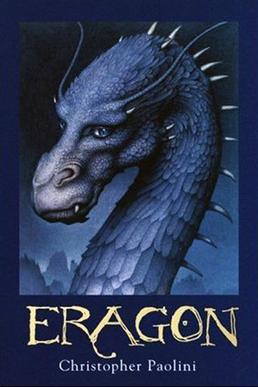
Eragon by Christopher Paolini- Eragon finds a blue stone in the woods which soon hatches into a dragon! Eragon keeps his new pet a secret, but that doesn't stop the Ra'zac—servants of the Empire—from getting suspicious and burning Eragon's uncle's farm. Eragon is forced to flee with his dragon, Saphira, and the old storyteller, Brom, who turns out to be much more than a storyteller. As they hunt down the Ra'zac, Brom teaches Eragon swordplay and magic and Eragon realizes that he and Saphira are far more important than either of them realized.
I enjoyed Eragon. I think its a good work of fantasy and Christopher Paolini must be credited for creating a working, coherent fantasy world. I enjoyed Eragon's growth throughout the book. I did, however, feel like Christopher Paolini "borrowed" too much from other franchises. Continually, I was saying to myself, "This reminds me of Star Wars!" or "This reminds me of Lord of the Rings!" and not, necessarily, in a good way. While it is good to learn from successful authors, to borrow too much from them is dishonest, even if it is unconsciously done.
Still, Eragon was an enjoyable book. I loved Paolini's take on magic. Magic in Paolini's book comes from a language of power, and using that magic costs the strength of the user. I thought that was really unique and more "realistic" than stories where magic does not "have a price," as Rumpelstiltskin would say in Once Upon a Time.

Ivanhoe by Sir Walter Scott- Ivanhoe is an exhilarating tale filled with knights, competitions, a damsel or two, and more than one familiar face. It is set during the Third Crusade—also known as the time of the Norman takeover, the time of Richard the Lionheart, and the time of Robin Hood—and follows the intersecting story lines of several characters. Ivanhoe, recently returned from the Holy Land, and his Saxon relatives clash with their Norman adversaries, Prince John ("Too late to be known as John the First, he's sure to be known as John the wooorst!") is trying to steal the throne from the missing King Richard, and Isaac the Jew is trying to protect his daughter, his hide, and his gold from persecutors.
So much goes on in Ivanhoe that I find it hard to write about. Really, all I can say about the whole book, and not just parts, is that it is epic and definitely worth reading.
My favorite characters were Wamba the Fool and Rebecca the Jewess. Her speeches against the Templar Knight's advances were wonderful; her loyalty to her faith astounded and inspired me. The Templar offered her love and riches—he even risked losing his status in his order just to woo her—but through it all, Rebecca remained stalwart in her Judaism. Honestly, I don't know if I would have persisted in my resistance, had I been in Rebecca's place. By standing strong in her faith, Rebecca shows women that they don't need a man to be content; God will fill the void, if you let him. Even if a man offers love and riches and even goes so far as to risk his reputation for you, it does not mean that he Mr. Right, especially if he means giving up your faith and your scruples. Rebecca is an unsung heroine of literature, I think. Her only fault is in her rejection of Jesus Christ as Lord and Savior.


Persuasion by Jane Austen- Kellynch Hall has become too expensive for Sir Walter Elliot's style of living and he and his eldest daughter must remove to Bath and rent the Hall. Anne Elliot, Sir Walter's second and often forgotten daughter, goes to stay with her younger sister's family, the Musgroves, where she meets with a former suitor and falls in love all over again. 
Persuasion is a lovely read. As it is one of Austen's last novels, it is more mature in its style; the heroine is certainly no Elizabeth Bennet. It is a rather quick read, only twenty-some chapters long, but it is full of delightful characters and a variety of different settings. I have enjoyed all of Jane Austen's novels (except Northanger Abbey, which I have not yet read), but I have especially enjoyed her more subdued novels like Mansfield Park and Persuasion. This book is a great read!

What have YOU all been reading lately?

Live long and prosper.

Monday, September 22, 2014

"What are men to rocks and mountains?" (Pride and Prejudice)

Bethany and Becca at Clever Bunnies recently did a Jane Austen tag and I decided to accept their general tag, since I haven't done a tag recently. Thanks girls!

Here are the rules:
The Rules: 
~Thank and link back to the person who tagged you.
~Tell how you were introduced to Jane Austen and share one fun fact about your Janeite life (this fun fact can be anywhere from "I stayed up all night reading Emma," to "I visited Chawton and met Anna Chancellor.").

~Answer the tagger's questions.
~Write seven questions of your own.
~Tag as few as one or as many as seven other Janeites and let them know you've tagged them.
In 2011, my mom introduced me to Jane Austen by getting the 2005 version of Pride and Prejudice out of the library one day. At first I wasn't interested because it was simply a romance story, but in the end I really loved it! That lead us to watch the 6-hour version... two or three times in one week... And then I read the book and have read it every year since 2011!

Here are Clever Bunnies' questions:

1)  If you were to name a child after an Austen character, which name would you choose?


I'm going to go with what seems to be the popular answer... Elinor. =) Elinor is such a pretty name! And I love the way Jane Austen spells it, with an "i" instead of an "ea." Isn't Aunt Elinor from Inkheart named after Elinor in Sense and Sensibility?
If I were to name a boy after a Jane Austen character, I would choose the name George (after George Knightley, not George Wickham), since George is already on my future-children's name list.


2)  Elizabeth Bennet and her sisters are all coming to your house for tea; what do you serve them, and what would you talk about?
I would serve them tea and fruit and little cakes and tea sandwiches. It's more of a 1910's meal, but I'm sure the Bennet's would like it. We would probably talk about the differences between the 1800's and the 2000's. Mary and I might discuss music.
 
3) If you were running down a hill in the rain, fell and broke your ankle, and a handsome young man jumped down off his horse to rescue you, would it be love at first sight?
Haha ha... no. It would be more like embarrassment and then worry that I'm being too much of a trouble and then worrying that he's gonna think I'm weird and stupid for running and falling in the rain. He'd drop me off at my house and we'd never meet again. The end.


4) Which Austen heroine would make the best companion for the Doctor?
I think Mary Crawford from Mansfield Park would be a good companion for the Doctor. She's not necessarily a heroine, per say... I bet Emma Woodhouse would have fun with the Doctor too.
 
(Or, considering that Billie Piper played both Rose Tyler and Fanny Price, maybe Fanny should be the Doctor's companion?)

5) Which Austen character most deserves a slap in the face?
Henry Crawford. Ugh.
 
6) If all the main characters from Jane Austen's books were attending a ball, who do you suppose would strike up the most engaging conversation?
Hm, intriguing question! I think Frank Churchill and Henry Crawford would get together and talk about the latest London fashions. Wickham and Willoughby would talk about being slimy womanizers. Mr. Knightley and Mr. Darcy might talk about running estates and their wives would probably giggle at them behind their backs.
 
7) If you and your favorite Austen heroine unexpectantly switched places for the day, what havoc would be wrought in both the literary world, and the real one?
My, my! If I switched place with Fanny Price, I would most definitely wreak havoc! I would start by telling her cousins and aunt and uncle to be nicer to her. Then I'd go find Henry Crawford and give him a nice big slap. =)
If Fanny were to come into my life, I really have no clue what would happen. She probably wouldn't wreak any havoc... She'd probably just sit around and absorb everything that was going on around her.

Live long and prosper.

Wednesday, April 2, 2014

Nightstand Books: The First

Nightstand Books is exactly what it sounds like: a post of what books are on your nightstand! This fun, new linkup is hosted by the fabulous Jenelle Leanne Schmidt and DJ Edwardson.
The first Wednesday of every month, you simply take a picture of the books that are currently on your nightstand, and write a post about them! (and link up with the others doing it)
You know me, I love talking about the books I'm reading... and this is the perfect opportunity to!
Without further ado... my nightstand:


Starting at the top, we have Great Expectations by Charles Dickens. I'm reading this for literature class and really enjoying it so far! Technically we're still on Wuthering Heights (which I also enjoyed... review coming in the nearish future) but I really wanted to get Great Expectations finished before the middle of this month, for secretive reasons I shan't disclose at the present. (Mwahahaha.)
From what I heard about Dickens, I had great expectations for Great Expectations (see what I did there?). Alright, maybe not great expectations, per se... But from what I had gleaned from other readers, Dickens is really super tough to read and get through. That had me apprehensive, but I was happy to find that he's not so difficult to understand after all! His writing style is similar to Jane Austen's in that it's old fashioned, but not indiscernible.

Next there is Thank You, Jeeves by P.G. Wodehouse. I discovered the world of Wodehouse in February and have fast fallen for his brilliant writing style and characters. His Jeeves books are definitely not to be taken too seriously and they make excellent brain candy reading. Thank You, Jeeves is the first Jeeves and Wooster novel (before it come several short story collections) and I'm enjoying it tremendously! My favorite episode of the TV series is based off of this story.

Third down is Jane Austen's Letters which is exactly like it sounds: a collection of Jane Austen's letters. Most of them are to her sister Cassandra and are, altogether, very interesting! I love reading people's letters or autobiographies, especially if the people lived in a historical time period. Textbooks and Wikipedia pages can only tell you so much about that time... but reading the everyday occurrences of someone who actually lived at the time can be so enlightening! It's like a peek into a different world.

Which brings me to... Agatha Christie's Autobiography. Everything I said about the above also applies to this book. Wow, what an interesting person Agatha Christie is! I recently finished a book of her letters to her mother when she traveled around the world with her husband in the 1920's (it was so so so good) and figured I'd just move right along into her autobiography. I haven't gotten too far into her life yet. She's only just entered the teen years. Did you know she never really wrote much as a child? She loved to read, and she had many make believe worlds and friends (including several imaginary train tracks in her backyard), but she never wrote. Instead she played piano, acted, danced, swan, and learned French. She wasn't an outstanding child - actually, she was rather normal. Her childhood games reminds me of my own.

Underneath those four books are three or four notebooks, several pieces of paper, and a folder or two. All are filled with stories or story ideas. Aaaand up in the left hand corner, you can see Dori photobombing. I decided to have his make a cameo appearance instead of the other half of my nightstand, which is the top of my dresser. It's rather messy, filled with bits of paper and bookmarks. I didn't think you'd be interested in that.

So what are YOU reading?

Live long and prosper!

Sunday, December 15, 2013

A bookish linkup!

Cait and Mime, over at the Notebook Sisters (which looks like a rather fantabulous blog, by the way, even though I haven't full explored it yet) are having an end-of-the-year bookish linkup!


Basically you have to answer the following questions and then link up your own post to their post. I'm doing the reading one... but there's a writing link-up too, which I might or might not do. I haven't decided yet.
Without further ado... the questions!

1. What was your overall favourite book this year? (Yes. Pick one.)
Hmmm... I'm going to go with Mansfield Park by Jane Austen. I really, really enjoyed that one.

 2. Favourite debut(s)? (Author must have been first published in 2013.)
Can I pick myself? :P Because I haven't read any books by newly published (in 2013) authors. I can get close, though! Miss Jack Lewis Baillot was first published December 14 of last year.

 3. Which books did you reread this year?
A lot.
To Kill a Mockingbird by Harper Lee (actually, I'm hoping to start this one again soon because IT'S AMAZING).
Ruby Holler, Replay, and Bloomability by Sharon Creech.
The American Girl Samantha series (which is technically 6 books, but I'm counting them as one, since they're so short).
Pride and Prejudice by Jane Austen.
The Princess Bride by William Goldman (also an amazing book - and movie).
The Great Gatsby by F. Scott Fitzgerald (does this count? 'Cause I read it... and then a few days later re-read it).
A Long Way From Chicago and A Year Down Yonder by Richard Peck (x2. I re-read them twice this year).
The Old Man and the Sea by Ernest Hemingway (though I don't really remember the first time...).
Ecclesiastes by Solomon (?).
The Penderwicks, the Penderwicks on Gardam Street, and the Penderwicks at Point Mouette by Jeanne Birdsall.
The Last of the Really Great Whangdoodles by Julie Andrews Edwards.
The Two Towers and The Return of the King by J.R.R. Tolkien.
The Swiss Family Robinson by Johann Wyss.
Journey to the River Sea by Eva Ibbotson (I love this book).
and
The Hobbit by J.R.R. Tolkien.
Phew!

 4. Favourite cover(s) this year!
I'm guessing this is favorite covers of the books I've read this year...?


 5. Worst cover(s)?
I don't really have any worst covers... If I have to pick, though, I guess I could go with the cover of Leviathan by Scott Westerfeld. It's an alright cover, but I prefer the one with the gears. And the Canterbury Tales Penguin classics version. That one has the author on the cover (to be fair, though, he is in the book as well).


 6. What self-published books did you read this year?
Kat and Kadet by J. Hammond (AKA Hailey Jenkins).
A Stretch of Loyalty by Miss Jack Lewis Baillot.
Abolished Impracticality by Miss Jack Lewis Baillot.
Sew, It's a Quest? by Kendra E. Ardnek.
and
Do You Take This Quest by Kendra E. Ardnek.

 7. Which book(s) gave you a massive hangover?
I'm not really familiar with book hangovers (or any hangovers for that matter...) but Abolished Impracticality left me going:

 
(I'm the one on the right. The one on the left is The Author, who can't comprehend my frustration)

 8. Best standalone you read?
I read a lot of great standalones. I'll go with one I haven't mentioned yet... Crater by Homer Hickam.

 9. Biggest book(s) you've read this year?
Moby Dick by Herman Melville is a clear winner! Followed up by Canterbury Tales by Geoffrey Chaucer and the Return of the King by J.R.R. Tolkien.

 10. Book(s) you followed the hype for and then loved!
The books my friends write I eagerly follow the hype of, and then love their books.

 11. Most disappointing book(s) you read this year?
The No Place Like Holmes books I was expecting more from.

 12. Favourite leading-female character?
Fanny Price from Mansfield Park by Jane Austen. You can read why on my review of Mansfield Park a few posts back.

 13. Favourite leading-male character?
Atticus Finch from To Kill A Mockingbird by Harper Lee. Beware future-firstborn-son-that-I-will-have-eventually—your name will be Atticus. It will!
I also really like Bilbo from The Hobbit by Tolkien... and Mr. Satterthwaite from The Mysterious Mr. Quin by Agatha Christie was pretty cool too.

 14. Best romance(s)?
Alek and Deryn from the Leviathan series by Scott Westerfeld!

 15. What book(s) hit the DNF list? (Did not finish)
Hmmm... lots, probably. The only one I can remember, though, is The Princetta by a French lady. I started it when we were visiting family across the country, and then never finished it when we came home.

 16. What book(s) did you read out of your comfort-zone?
I'll say Heist Society by Ally Carter. I don't normally read YA books and I tend to be a little wary of them...

 17. Which author did you read the most from?
Agatha Christie! I started reading her in the spring and have read seven of her books now. Second place is J.R.R. Tolkien, of whom I have read five books this year (The Two Towers, The Return of the King, The Father Christmas Letters, The Hobbit, and Sir Gawain and the Green Knight).

 18. Top 5 books you'd recommend from all the books you've read this year?
Oooo, hard question!
Probably...
To Kill a Mockingbird by Harper Lee - because I love love love that book.
The Princess Bride by William Goldman - because I also love love love that book and any fan of the movie will be equally impressed with the book.
Crater by Homer Hickam - this is a great space adventure with amazing world building.
And Then There Were None by Agatha Christie - every fan of mystery should read this. Any fan of amazing writing should read this. Only, don't do it while you're camping on an island.
aaaannndd...
The Clockwork Three by Matthew J. Kirby - this was a really fun adventure-read. I really enjoyed it.

 19. How many books did you read this year all up?
66, so far! That's amazing! I don't know if I've read that many books in a year before. And I know for a fact that I will be finished one or two more before the year is up.

 20. What's a book you're hugely excited for coming out in 2014?!
The fourth Penderwicks book!

Live long and prosper.

Tuesday, December 3, 2013

Mansfield Park: A Review

Or, if you want to read the title differently-
Mansfield Park: Abbey's thoughts and comments. (P.S. Major spoilers coming up. Pretty much everything is a spoiler. Not only for Mansfield Park, but other Austen works as well. Tread carefully.)

Title and author: Mansfield Park by Jane Austen.

My rating: Hovering somewhere between nine and ten stars out of ten.

Synopsis: Taken from the poverty of her parents' home, Fanny Price is brought up with her rich cousins at Mansfield Park, acutely aware of her humble rank and with only her cousin Edmund as an ally. When Fanny's uncle is absent in Antigua, Mary Crawford and her brother Henry arrive in the neighbourhood, bringing with them London glamour and a reckless taste for flirtation. As her female cousins vie for Henry's attention, and even Edmund falls for Mary's dazzling charms, only Fanny remains doubtful about the Crawfords' influence and finds herself more isolated than ever. (Taken from Goodreads.)

My ramblings: Mansfield Park is very understated and underrated in my opinion. It is not many people's favorite. Not many people enjoy reading this book. It lacks a witty, fun, main character. It lacks the scoundrel man (well, it does have a scoundrel, but more on him later). It lacks the Mr. Darcy or the Mr. Knightley - the dashing hero. It lacks the comic relief character - the Mr. Collins or Mrs. Jennings. In all reality, it even lacks the love-story focus. The story is about love, but it's not about getting married. It's not a very funny story. It's rather depressing in some parts. It's sad in others.
But I think it's brilliant.
I love Mansfield Park.
I think it's my favorite Jane Austen novel.
After watching the movies for all of Austen's novels (before reading any of the books), Mansfield Park stood out to me, and I'm not sure why.
After finishing Emma a few months ago, I knew that Mansfield Park was the Austen novel that I wanted to read next.
Sometime in the beginning of November, I picked it up and started reading. I couldn't put it down. Though nothing really exciting happens in the book (no explosions, no treasure-stealing dragons, no big fight scenes), it is the first book in months that had me wanted to read more, to find out what happens next. This rarely happens when I read, so it was a pretty exciting feeling.
So what exactly makes this book so endearing to me?
I think it the characters.

Let's talk about Fanny Price first.
Fanny is the "heroine" of the novel (though as someone on Goodreads pointed out, the novel is not entitled "Fanny" or "Fanny Price;" it is entitled "Mansfield Park" and that's what it's about. The goings-on at Mansfield Park. We just happen to be seeing things through Fanny Price's eyes).
Even though Fanny is the heroine, she really doesn't seem like it. She has none of the characteristics of Austen's other heroines. She is not out-going. She is not funny. She is not smart or witty. She can't play the pianoforte, she doesn't sing, she can't paint, and she doesn't know her geography.
Fanny is timid, shy, nervous, and weak (health-wise). Austen describes her thusly: "extremely timid and shy, shrinking from notice." All of Fanny's education comes from reading, and discussing the books she read with her cousin Edmund. Edmund is to be a clergyman, and therefore instructs Fanny in what is right, proper, and moral. She is, therefore, a very moral character.
When Henry Crawford comes to Mansfield and flirts with Fanny's engaged cousin Maria (as also her unengaged cousin Julia), Fanny can't like him. She believes his actions wrong. Later, when Henry starts paying his attentions to Fanny, Fanny still can't like him. His opinion grows slightly in her mind when his attentions don't stop and he genuinely seems to love her. But she still cannot like him enough to marry him, due to her belief that he is prone to flirtation and is not capable of a steady, constant love. She ends up being right in the end, though that rightness comes at a great cost to everyone's happiness around her.
Many people have a problem with Fanny's morality, which I don't understand. They think she's too perfect. I don't think that at all. I think that considering the times, and how she grew up, who influenced her (cousin, clergyman Edmund), and her personality, her morality isn't to be wondered at. She's a girl with convictions, and she's willing to stick to those convictions to the very end. That's a rare thing now, which is why I think people have a problem with it.
So why do I like Fanny so much? Well, for one, I LOVE her convictions. I love that even though Henry Crawford truly did love her, and even though her marrying him would have elevated her SO much in society, and even though they would have been a good match, and even though all her family were of the opinion that they should marry... and even though her uncle got very upset at her for not marrying Henry, and even though Henry got Fanny's brother a promotion... even though Aunt Norris was very angry about Fanny not marrying Henry... even though Fanny felt horrid and cried and cried because of all the disappointment she was giving to the family that had taken her in... even through all of that, she still stayed true to herself and to her conviction that she shouldn't marry Henry. It caused her a lot of pain, but she stayed true to what she believed. Even though she is shy, nervous, timid, scared, and of weak health... she was strong enough to continue to refuse Henry's attentions, even though they continued for months.
That's admirable.
Another reason I like Fanny? Edmund.
One of the reasons that Fanny refuses Henry (along with not liking his character), is that her heart is already someone elses. She's in love with her cousin Edmund. Unfortunately, Edmund is in love with another girl - Henry's sister Mary. Fanny sees that Mary is just as wrong in character as her brother, but Edmund doesn't see it. He's too blinded by what he thinks Mary is... And because he and Fanny are such good friends, he tells her everything. Fanny endures listening to the man she loves, talk about another woman. She endures him pouring out all of Mary's amiable qualities. How gracefully she walks, talks... Yet Fanny is able to listen, and she able to be Mary's friend and correspondent (though it pains her). She still loves Edmund through all of it. And when Henry wants to marry Fanny, she doesn't even for a second think about marrying him, because her heart is Edmund's and will be forever (though Austen does hint that if a certain thing concerning Henry and Fanny's cousin Maria didn't occur, and if Edmund had married Mary, eventually Fanny might've married Henry and been content and happy with him).
That's admirable too. I hope that I have that much constancy. Not just to my husband, but to my friends and family.
Another reason I like Fanny is because I'm so much like her. And it's not just because we both don't know where Asia Minor is.
In one way, I'm not so much like Fanny, as I am inclined to be like her.
My tendency is to be shy, to be timid, to look at the floor when people are all around talking. I've never been popular and don't want to be. When people are having a party around me, I generally find a place to sit and spend the time trying not to make eye contact with people, so that I won't have to talk. This happened just this past weekend when we were celebrating my dad's birthday in Canada. Instead of joining the rest of the people in the living room/dining room for dinner, I hid away in the kitchen, so that I wouldn't have to be talked to.
(As a side note: I'm SO SORRY to my cousin. I feel like I kind of abandoned you to the relatives and I'm very sorry about that.
Another side note: Thank you to the uncle who came and talked to me about my book. =) I appreciated that. Though I'm not sure he'll ever know, since I'm pretty sure he doesn't read my blog...)

This aversion to people is something I'm trying to get over. I see it as a flaw. God created people to be in relationship with one another, not to be loners. I will never make the friends that I ache for if I'm not getting out there and talking to people. I can't have good, meaningful relationships if your always staring at the floor!
Fanny also, is rather shy around people. She often looks at the floor, instead of joining in on conversation.
The mix of Fanny's timidity and morality makes her alienated from all the rest of the young people. Add to this that Fanny has never been properly "out" in society, and the fact that most of the time she is running errands for her Aunt Bertram, while her Aunt Norris takes every opportunity to scorn her, and it is no wonder that, while her bright, pretty cousins Maria and Julia are in the room, no one ever talks to Fanny!
While I don't have a scorning aunt, and don't have an aunt to run errands for all the time, and I don't have any popular people always taking the spotlight, I do feel like my own strong morals and convictions set me apart from others. It's hard to be a Christian. It's hard to stay pure, and it's hard to stay focused on what's right and noble, when the whole rest of the world is wearing skin-tight, revealing clothes. Or when the whole rest of the world is watching that One TV Show that you don't want to watch because it dirties your mind. It's hard when everyone around you talks about trivial things, or when everyone around you is fangirling about Such and Such a show, and you're stuck in the middle going "THERE'S SO MUCH MORE TO LIFE!" Knowing that God fulfills, that he's the best way, but still having a little wishful thinking in your heart... wanting to fangirl, to fit in with the others, because that TV show really is so brilliant, and the actors so amazing... But I don't. I won't let those things get in the way of God. I won't let them become an idol in my life.
Fanny struggles with some of the same things, though she does it more in the name of Rightness and Morality, that in the name of God. In the beginning of the book, when the Henry and Mary Crawford first arrive, a scheme is presented to pass the time: Acting. Only, the play that is chosen is inappropriate and shocking and surely something that Uncle Bertram would NOT approve of, were he at home (he was away in Antigua dealing with some business). Only Fanny refuses to participate in the play, because she knows it's immoral, and that her uncle wouldn't approve. Yet there is a point where Fanny has her heart tugged a little bit... Everyone else is having so much fun with learning lines and rehearsing and everyone is such good friends. And there is still one part, even if it is small... But then the part is taken by the Crawford's half-sister and the temptation is taken away.
I know how hard it is to deal with stuff like that... it's difficult to say 'no.' It's difficult to take the straight and narrow path.
“We have all been more or less to blame,” said he, “every one of us, excepting Fanny. Fanny is the only one who has judged rightly throughout; who has been consistent. Her feelings have been steadily against it from first to last. She never ceased to think of what was due to you. You will find Fanny everything you could wish.” (Chapter 20. Edmund to his father, when his father returns unexpectedly from Antigua, to find the house in disarray, and the acting in full swing.)
I love Fanny's convictions and her consistency on those convictions.

Now, I want to talk about Henry Crawford and how brilliantly well-written he is.
Henry is a silver-tongued, flirtatious man from London. He's not out-of-this-world handsome, but he has pleasing manners, and a family estate. He reads beautifully.
He also likes to make girls fall in love with him, only to break their hearts because it's only a game to him.
He makes Fanny's two cousins, Maria and Julia fall in love with him. It's alright for Julia, because she's unattached. But Maria is engaged to Mr. Rushworth. Eventually, after Henry leaves, Maria marries Mr. Rushworth for his money. Truly, he's an idiot, and Maria can't get Henry Crawford out of her mind.
After Maria and Mr. Rushworth leave on their honeymoon, and take Julia with them, Henry returns.
He says to his sister: "What do you think I shall do during to occupy myself during the next few weeks? I am going to make Fanny Price fall in love with me. She needs to have her heart broken just a little."
Mary urges him not to do it, but he will have his fun.
It turns out not to be so much fun when Henry actually falls in love with Fanny himself, and Fanny won't have him.
Everyone tells him to be patient and wait for Fanny, though, because she often needs to have a few months to get used to the idea (after all, Henry is her first suitor). So Henry is content to wait for a few months. But then, when he's in London later, he meets again with Maria. She acts very coldly towards him, because he broke her heart. This upsets Henry. The woman he had so much control over not six months before now totally ignores him! So he starts to flirt, and tries to make Maria fall back in love with him. He succeeds of course, and starts an affair with her. If they are careful enough, Fanny will never have to know about it and he can have his fun, and marry the woman he loves. But, of course, it all comes out, and gives Fanny even more reason not to marry him. Both he and Maria are disgraced.
But the way that Jane Austen portrays him! Oh, it's genius on paper. When Henry first shows up, he is detestable. He is as much a scoundrel as Willoughby and Wickam. And then he says that he's going to try make Fanny - innocent, modest Fanny! - fall in love with him! At that moment, he is the most detestable scoundrel ever! But then he falls in love with Fanny... He shows his devotion to her. He becomes good friends with her brother and even gets him a promotion. When Fanny goes home to her parent's house for a three-month visit, he even comes for a few days expressly to see her. I almost started to like Henry Crawford. He certainly was changing. He is everything honorable and right for a little while. You almost start to root for HenryxFanny. And then he starts the affair with Maria and you're thinking, "Henry! What are you doing! If only you had waited, man! You would have eventually had the woman you loved! Now you totally scrapped your chances!"
All the conflicting emotions! It takes a genius to write such a character - that makes you detest him, then love him, then detest him again; that makes you almost wish that he had stayed good...
This is one of very few books - perhaps even the first since I can't remember any others at present - that have made me feel this way towards a character.

Henry Crawford is not the only example I have of Austen's genius, however. She is able to portray different sides of the same coin beautifully. What I mean is that she can take a social position and portray it in a good light, a bad light, and a 'eh, whatever' light. She has done this in several different books, though I have only noticed after reading Mansfield Park.
Take the office of clergyman for example...
In Pride and Prejudice (and also Emma) the clergymen characters are complete buffoons. You have Mr. Collins, whose sole purpose in life is to marry a respectable lady, and please his patron Lady Catherine de Bourgh. In Emma, Mr. Elton is a selfish man, whose better-than-thou attitude gains him a horrid wife.
Yet in Sense and Sensibility, Edward, who wants to be a clergyman, but is deterred from that line of work by his mother, is to be felt for. His line of work seems perfect for him. You want him to be a clergyman. You know he'll be good at it.
In Mansfield Park, it's taken a step further. Actually, it's a topic of debate between several of the characters several different times.
Edmund wants to be a clergyman. He has always wanted to be a clergyman. Not because of the pay, or because of his patron, or because of selfish reasons... but because he genuinely wants to help people and make people better. He also wants to marry Mary Crawford, who is totally against clergyman in general. There is a clash of opinions and several debates follow, where you get to see Mary's reasoning, and Edmund's. It's quite amazing, because you can truly see the different sides and can feel for both sides.
She does this with others characters as well. Take Elizabeth Bennet and Mary Crawford, for example: They are both witty and pretty, with lovely dark eyes. They are both lively and easy-going and fun to be around. The difference is that Elizabeth is the main character in Pride and Prejudice, and Mary Crawford is not the main character in Mansfield Park. (Of course there is also difference in situation... Mary has 20,000 pounds, while Elizabeth is basically penniless.)
How different would Mansfield Park had been if it had been from Mary's point of view? Would we see more similarities to P+P? What about the whole clergy issue? Would we have agreed with Mary if it had been from her point of view, or would we still had agreed with what Edmund had to say?

Even though Mansfield Park lacks elements from Jane Austen's other novels, I believe that this is most certainly NOT her worst work. In fact, I think it's one of her best. It shows her genius with characters.
And it shows Jane Austen's diversity as a writer. It shows that she's capable of writing vastly different works. She can write lighthearted, almost "fluffy," books like Pride and Prejudice, and she can write the darker, deeper books like Mansfield Park.
People don't like Mansfield Park because of it's deeper, darker side. They want another Pride and Prejudice love story.
But is an actor who played a sociopath brilliantly once, and from then on was just cast as sociopaths because that's what he's good at, really a good actor?
Is a hit musician who keeps writing songs about the same types of things, only changing a chord here or there to make the song different enough to keep people interested, really a great musician?
Is a best-selling author really so amazing, when all her works are fluffy romances (even if the names of the characters, and the settings are changed)? Or if all his works are spy thrillers, with different endings, but the same way of getting to that ending, is he really so brilliant? (I should do a post on this... because I feel like Agatha Christie does this. Her endings are always a surprise, but I believe that's because she always gives the reader SO many suspects, and they ALL have motives and things in favor of or against them. There are some exceptions, of course... *cough cough* And Then There Were None.)

I believe that Mansfield Park proves that Jane Austen is a very talented, diverse author. Every time I read a book of hers, I hold her in higher esteem.

So there you have my rambling review of Mansfield Park. =) This book isn't for everyone. If you're a fan of adventure and intrigue and comic relief characters and explosions, this book probably is not for you. But if you enjoy books about people, and enjoy appreciating/thinking about/analyzing great writing, then you would probably like this book. Also if you like somewhat sad books that give you lots of feelings. Also if you like books that make you think.

Live long and prosper!

Thursday, August 29, 2013

Emma by Jane Austen - a review.

Title: Emma.


Author: Jane Austen (O.o I did not know that her name was spelled with an E instead of an I until just today. So the label on this post will still say Jane Austin, instead of Jane Austen. Funny thing to not notice, right? EDIT 12/22/14: I've just got an changed the label because otherwise it would annoy me.)

Synopsis: Beautiful, clever, rich - and single - Emma Woodhouse is perfectly content with her life and sees no need for either love or marriage. Nothing, however, delights her more than interfering in the romantic lives of others. But when she ignores the warnings of her good friend Mr Knightley and attempts to arrange a suitable match for her protegee Harriet Smith, her carefully laid plans soon unravel and have consequences that she never expected.
(From Goodreads, because I couldn't think one up.)

My rating: 9/10 stars.

Things I didn't like/things you should know: I can't think of a single thing that was wrong about this book, in terms of cleanness. Emma takes God's name in vain a few times near the end of the book.... But that's about it.
One thing, however, annoyed me. Numerous times throughout the book, instead of saying, "I went to the store and bought some apples because I am going to make an apple pie," Jane Austen wrote, "She went to the store and bought some apples because she is going to make an apple pie." She would put it in quotations, but write it as if it weren't in quotations. That annoyed me.

My thoughts: This was a great book! I'm a fan of Jane Austen anyway. Emma doesn't quite top Pride and Prejudice (or Sense and Sensibility... though I'd need to re-read that one before making up my mind entirely), but it is a wonderful book! I especially loved the last 19 chapters (part three, in my version). The last 19 chapters is when all my favorite parts happen - the ball, Box Hill, the proposal.... *dreamy sigh.*
Emma is very well-written and has Jane Austen's usual humor, which I love.
What I really loved about this book, though, was the character development. The book takes place over a period of about a year and Emma learns and changes through that year. You can see her innermost thoughts, and can see how her mistakes make her into a better person. She's a totally different person by the end of the book, than she was at the beginning. I love seeing that in literature.

Would I recommend this book? Yes! To fans of books like Jane Austen's, Emma will delight.

And if you don't want to read the book.... go watch BBC's 2009 version of Emma! It is amazing! Very accurate to the book, I think - and just beautiful to watch.

 
Live long and prosper!

Tuesday, February 5, 2013

Top Tuesday: Top Eleven Period Dramas.

I am starting something new. Every Tuesday I will post a list of my "Top ______ _______'s."
Today, I will be starting with my Top eleven favorite period dramas. I will start with the highest number and end with my number one favorite.
(Also, just by the way, I have seen at least five more period dramas than those on the list, but since they didn't make a huge impact on me, they won't be listed).

11. Cranford.
Cranford is a lively drama set in a small town in the 1840's.


Cranford is run by the ladies, who love to gossip and tell all sorts of stories.
Cranford (and Return to Cranford) is full of fun, lively characters who do hilarious things (like dress up the cow in pajamas and put a bird in a hoop skirt).
I enjoy Cranford, although it's a bit too sad.... Everyone dies! Well, not everyone. But a whole lot of people die - and I don't like stories where people die all the time. (MOFFAT!!!)

10. Sense and Sensibility (2008).


I did a review (of sorts) here.

9. Mansfield Park (1983).


Mansfield Park is one of the less-popular Austin novels... and the film adaptions don't do too well either, I think. I, however, love Mansfield Park. I don't know what it is about it... I just love it. This particular version is probably my favorite because it's the one I saw first, and I really like the actress who plays Fanny. I also love it when Fanny goes home... Her family is so strange.
I've seen one other version of Mansfield Park... One starring Billie Piper as Fanny. I really enjoyed that one as well... But for some odd reason, I don't remember much of it. Maybe because half the time I was going, "Rose! Rose! Why are you in the 1800's Rose? Did the Doctor drop you off?!" and the other half of the time I was going, "MR. ELTON! How come you aren't despicable in this one? You're so nice! How is that possible?!"

8. Downton Abbey.


Most people have heard of Downton Abbey. It's one of those popular British shows that everyone loves... Kind of like Doctor Who, Sherlock, and Merlin. It's set in the early 1900's, and shows the rich life of the Crawley family, and their servants. The social structures collapse during the First World War (which takes places in Season 2) and master fights next to servant.
It is all very interesting and a great show (although there is some questionable material).

7. Persuasion (1995 - It was a very good year.... for Jane Austin films....)


Because it's Jane Austin. And I love this adaption, even though I haven't seen any other ones, and even though I haven't read the book, and even though I have no clue if it's accurate or not.

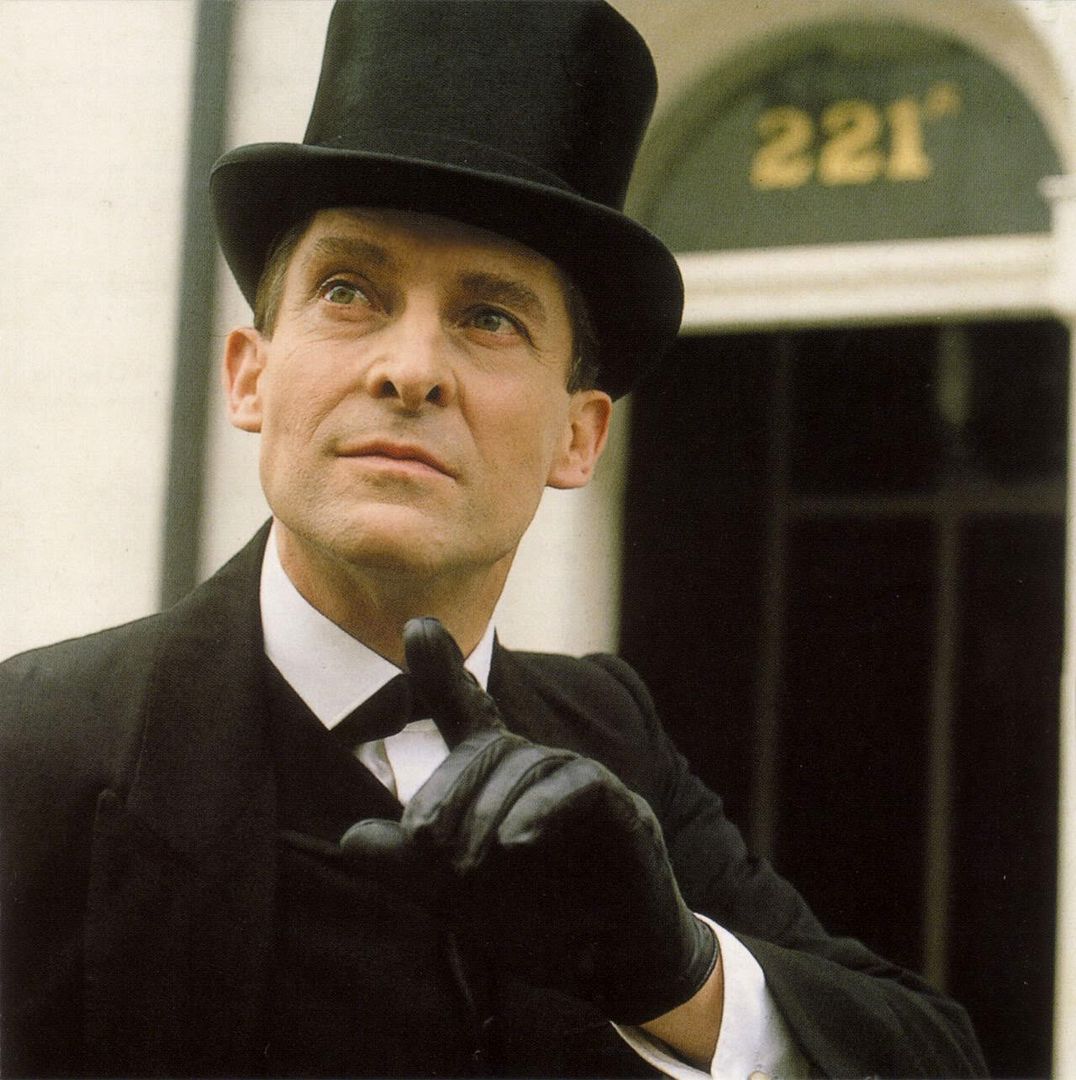
6. Sherlock Holmes, starring Jeremy Brett.


THE best interpretation of the Sherlock Holmes books that I have seen. It is so accurate to the books. Jeremy Brett would read each script and if something wasn't like the books, he would make the writers change it.
He looks like Sherlock Holmes, he acts like Sherlock Holmes, he IS Sherlock Holmes.

5. The Scarlet Pimpernel (1982).


I saw this recently and oh my word... It was amazing! I have heard great things about it and boy, my sources were right. Now I really want to read the book (though I've heard the movie version is different from the book).
I laughed so hard at some parts... Great movie. "Sink meh!"

4. Sense and Sensibility (1995).


Colonel Brandon = Alan Rickman! Enough said.
Hee hee kidding.
Sense and Sensibility is one of my favorite Austin books, and this version with Emma Thompson is great. She's a wonderful actress. Everyone else fits their parts well also. Except maybe Edward... I have yet to find a perfect Edward.

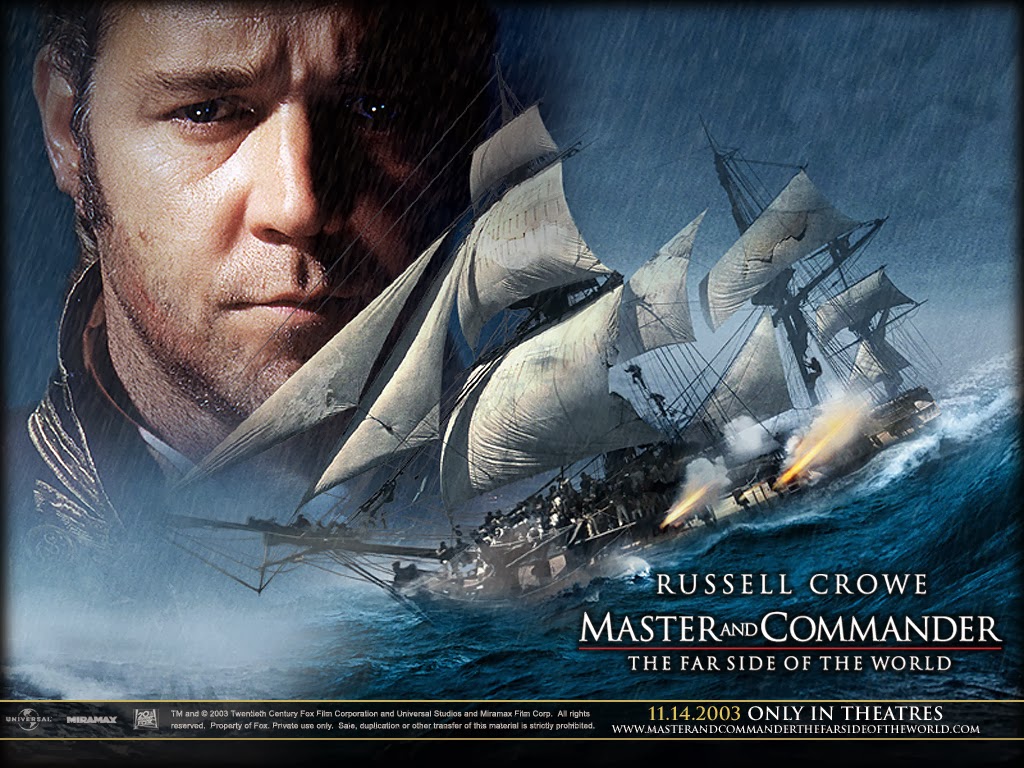
3. Master and Commander.


I'm not entirely sure this counts as a period drama... But whatever, it's one of my favorites.
The music is amazing, Russell Crowe is amazing, the doctor dude whose name I never remember is amazing... It's all great. Plus it takes place on a ship! I love stories that take place on ships, on stories where people are on a ship that gets shipwrecked.
Anyway, it is one of my all time favorite movies. (Warning: There is one use of the F-word.)

2. Pride and Prejudice (1995 - told you it was a good year for Jane Austin adaptions).


This is one of those period dramas that I will never get tired of watching... Even though it is six hours long. It just has a way of drawing you in... Ask my dad! We started watching it with him and then my mom and I went on our big trip over the summer and he finished watching it without us!
This adaption of Pride and Prejudice is also the most accurate to the book that I've seen.

And now... *drumroll* my favorite period drama.....

1. Emma (2009).


This is another of those period dramas that I could watch over and over and over again.
Emma is by far my mom and I's favorite. I haven't read Emma, but from what I gather, this version is very close to the book.
Plus the costumes are beautiful! And the music is wonderful! And the actors are brilliant! (See Jonny Lee Miller on the right? Sherlock Holmes from Elementary!)

And there you have it! Tomorrow I will try my best to comment on every one's blogs... since I haven't for a few days. I have been reading all your posts, though!

Live long and prosper!

Monday, August 20, 2012

Sense and Sensibility 2008.

Tonight my mother and I watched Sense and Sensibility, the 2008 version. It is 3 hours long (3 episodes) and was very good! Here is my review (warning: contains spoilers!):


Sense and Sensibility is the story of the Dashwood females. The mother and her three daughters, Elinor, Marianna, and Margaret. The girl's father has just died and his son from his first marriage is coming to take over the family home with his awful wife. The Dashwood sisters and their mother are forced to move into a country cottage.
Elinor and Marianne face love and deceit and situations make the girls choose between sensibility or despair.

This is the third version of S+S that I have seen; the other two being the 1995 movie with Emma Thompson and the 1981 mini-series version.
My favorite of the three has to be the 1995 one because the characters are so vibrant and I love Alan Rickman as Colonel Brandon (my favorite Jane Austin hero along with Mr. Knightley). The 1981 version is very good if you want to stick close to the book, but it is also a tad bit boring and dry.
I found that this 2008 version is a pleasant mixture of the two!
The storyline stayed pretty close to book, but also had the fun characters and in-jokes from the 1995 version.
Another thing I enjoyed about this version is that they added such scenes as the duel between Colonel Brandon and Willoughby and Willoughby showing Marianne around Allanham. Margaret, the youngest Dashwood sister, also had a more prominent role than she did in the book (in the 1981 version she was cut completely out of the show!). Also, this version had all of the characters from the book (in the 1995 movie we find that Sir John Middleton's wife and four children and Lucy Steele's sister, among other characters, are cut from the movie - this version included them all).
The dialogue was more or less like the book.
I loved how they kept the scenes from the book that were excluded from the 1995 version; such as, dinner with Mrs. Ferras and Willoughby's apology scene.
However, there were certain scenes which were NOT in the book that I wish the makers of this show had left out.... The very beginning scene show the seduction of Willoughby to Colonel Brandon's ward. It is about 30 seconds to a minute long and I just fast fore warded through it (I had been forewarned about it). This scene was absolutely not necessary to the plot line, as Colonel Brandon explains, more or less, what happens later on in the show. I wish that this scene had been left out but since it is in this version, fast fore ward through it.
Also, Willoughby and Marianne kiss while exploring Allanham and I think that could have been left out because it was not in the book. If I am going to be VERY picky, I would have left out the kiss at the very end between Elinor and Edward.... But I won't be picky this time. =)
Other scenes were changed slightly from the book and I believe one or two minor scenes of everyone at the Middleton's were left out... But they weren't important so that's alright. The biggest change, I think, was that Marianne didn't choose to study for a few years, like she did in the book and other versions. Colonel Brandon invites her to come to his home whenever she likes to practice his piano forte and read his books, which she does. They become engaged before Elinor and Robert. In the book it is the other way around, and it takes a few years.

Now onto the characters! I want this post to be mostly about the characters and how I compare them to the other versions and what I thought of them.

First, Elinor Dashwood played by Hattie Morahan.


I think that Ms. Morahan played Elinor exceptionally. She and Elinor really seemed to be one and the same. Emma Thompson from the '95 version is still my favorite... But Ms. Morahan LOOKS like Elinor, which is something I like. While Emma Thompson plays Elinor very well, she seems a bit old for the part. This Elinor was young and lovely.
Elinor had a great relationship with her sisters and held her composure very well during those four agonizing months that she had to keep Lucy Steele and Edward Ferras (the man she loves) engagement secret. She was very happy and comforting towards Marianne and had only good things to say about Mr. Ferras, even after his engagement became public.

Marianne Dashwood was played by Charity Wakefield.


I thought that Marianne was played very well also. You could see that she was enraptured by Willoughby the moment she lay eyes on him, as she was in the book. Her grief was played wonderfully when Willoughby left her but she also recovered very well. All in all, she was very much the Marianne from the book and I really don't have many complaints. Except maybe that she would wear her hair up more... I didn't think Jane Austin women were supposed to wear their hair down a lot and this Marianna does. I don't know, maybe I am mistaken. If I am, tell me. =)

Willoughby was played by Dominic Cooper.


Willoughby was very much like his book counterpart as well. The only problem is that he looks evil. From the very beginning he looks like he is going to do something wrong. Not because of the way he acts but simply because of his facial features. He just looks evil!
I do think Willoughby was acted well, though.

Edward Ferras was played by Dan Stevens.


I was so happy to see him! I know Dan Stevens from Downton Abbey and was pleased to see him another period drama! I think he has the face for it.
Anyway, Edward was very good. I liked this one better than the 1995 version. The 1995 version was, well, TOO awkward. Edward is supposed to awkward but not that awkward... He's not a dofus.
While the 1995 version was too awkward, this one wasn't awkward enough. Maybe it was because he didn't have very much screen time (Edward really isn't in the book or movie(s) very often....). Anyway, this Edward seemed a bit too refined but he was better than the too-awkward Edward. Plus I like Dan Stevens and he had a cool coat so Edward was good.

Colonel Brandon was played by David Morrissey.


When Colonel Brandon wasn't looked like the above picture, he was shooting daggers out of his eyes at Willoughby:


My dad walked in right at the above scene and commented, "If looks could kill...." I couldn't agree more.
Colonel Brandon was acted pretty good. He seemed to switch between total melancholy to great happiness to I'm-gonna-kill-Willoughby very quickly but subtly.
I like Alan Rickman's Brandon much better, but this one was great to. The character is just so pure with such good intentions it is hard to dislike him (although I must admit, the 1981 version was horrid). This Bradon seemed very super heroish to me. And I loved his red jacket.
Over all he was pretty good although I kind of wished he and the actor who played Mr. John Dashwood (Elinor and Marianne's half brother) had switched roles....

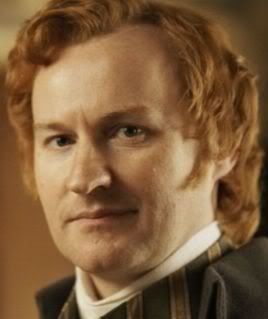
Mr. John Dashwood was played by.... drum roll.... Mycroft! *ahem* Excuse me, by Mark Gatiss!


He was soooo weird with long orange hair. Yes, Mark Gatiss does have reddish orange hair in real life... but it's not that long!
I thought that he played John Dashwood very well and I loved all his expressions - seriously, Mark Gatiss has some of the best facial expressions ever. He's up there with Daniel Jackson, Mr. Darcy, and Mr. Knightley.

Mrs. John Dashwood and son. The son was funny to watch. He was cute. The mother was absolutely detestable. She made no effort to hide her dislike of the Dashwoods and was commandeering to her husband. In the book she was more subtle of her feelings towards the Dashwoods. I think that this one was trying too hard to be dislike able.


Sir John Middleton and family. As I said, I loved to see the Middleton family even if they didn't have a huge part in the movie and didn't say a word. Sir John had a smaller part than I expected and wasn't quite so jolly as in the book and 1995 version. He was alright - I found him kind of creepy.


The Miss Steeles (Anne on the left, Lucy on the right). They had very small parts but were played well. I loved Anne Steele. She was really funny and it was great to see her in this version. She was left out of the 1995 version. I thought they were well played.


Mrs. Dashwood was kind of just there. She didn't have that big a part and didn't think she was overly emotional. Still, she made a good mother and was well played.


Mrs. Jennings wasn't as jolly as she was in the books and 1995 version but she was alright, I suppose.


Finally, Margaret. I loved her. She was played very very well and was about the right age too! She had a similar personality to the 1995 version and spent a lot of time running around yelling, "Willoughby's here! Colonel Brandon is here! Robert is here!" But she was fun to watch and her interaction with her sisters was great.


Over all this version was very very good! I would watch it again and would recommend it to any Jane Austin, period drama, or Sense and Sensibility fan.

Live long and prosper.